
“I’m interested in medical coding. Where do I start?”
“I passed my certification exam. Why do job listings still ask for experience?”
“I already work in healthcare. How much would I need to learn?”
These questions come from different points in the same journey. Yet much of the advice about becoming a medical coder focuses on one milestone: getting certified. That leaves people wondering what comes before it—and what happens afterward.
Learning to code, passing an exam, finding a role, and becoming confident at work are connected milestones. Each takes preparation of its own.
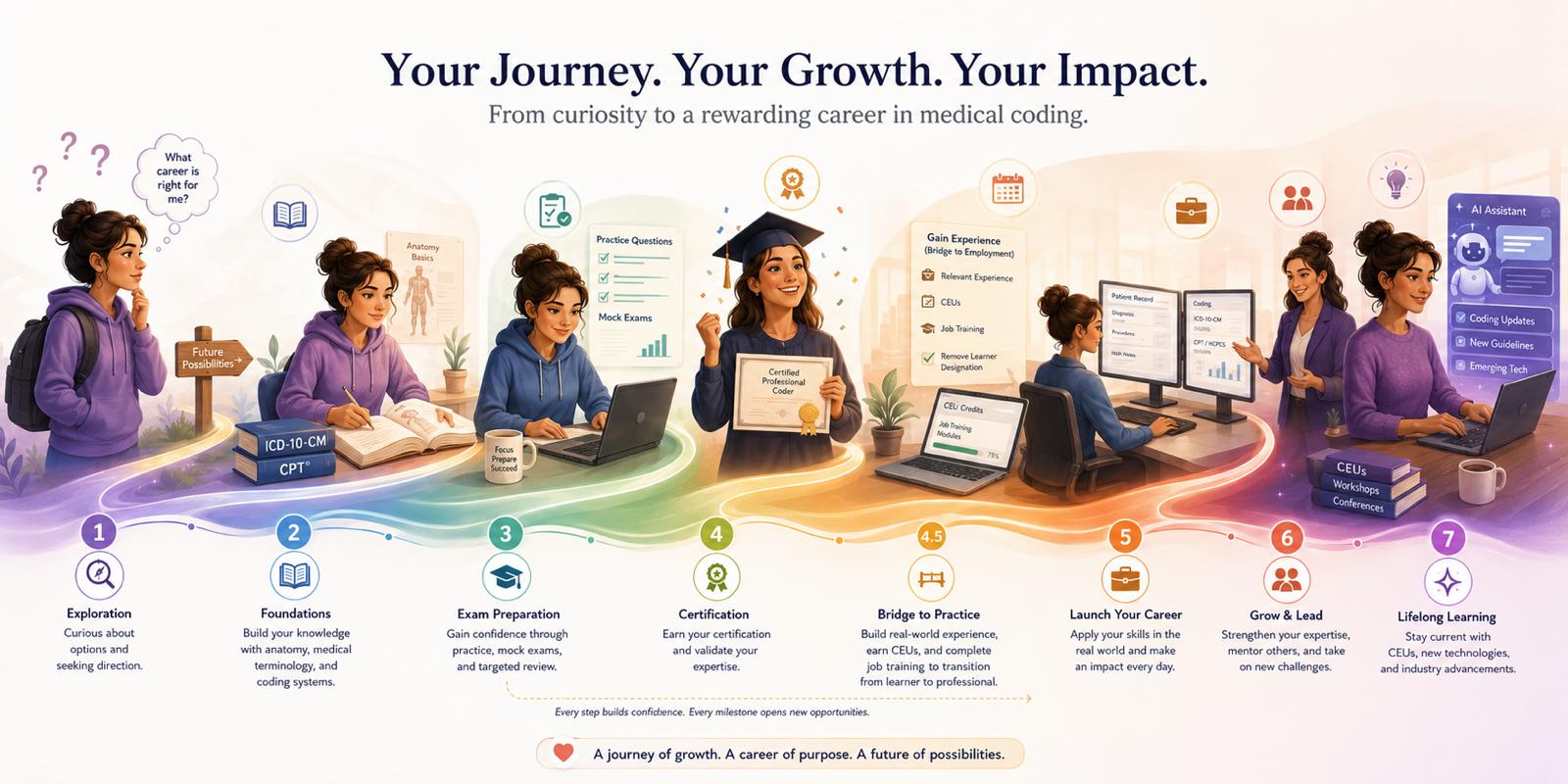
The illustration maps a common path through them. You can use it to find your starting point, understand what comes next, or see how far you have already progressed. Stages often overlap, and people enter with different backgrounds. You do not need to follow an identical route to build a career.
1. Exploration: “Is medical coding right for me?”
If you want to enter healthcare, medical coding is one way to contribute through work with documentation, information, and reimbursement.
Coders review healthcare records and translate documented diagnoses, procedures, and services into standardized codes. The work involves careful reading, research, attention to detail, and applying rules to the information in front of you.
You do not need to memorize every code. You do need to become comfortable looking things up, checking instructions, and explaining why a choice is supported.
Before enrolling in training, explore where coders work. A physician practice, an outpatient facility, and an inpatient hospital can have different coding needs. Your intended setting helps determine what you should study and which credentials may fit your goals.
Read several job descriptions—even if you are not ready to apply. Notice the duties, credentials, and experience they request. This makes the career more concrete and helps you evaluate training options.
Your next step: Choose a direction to investigate. You can refine it as you learn more about the field.
2. Foundations: “What do I need to learn?”
Coding starts with understanding the record.
Most beginners study medical terminology, anatomy, physiology, disease processes, and healthcare documentation. These subjects help you recognize what a provider is describing and understand how the pieces relate.
You then learn the coding systems used in your intended setting. In the United States, these commonly include ICD-10-CM for diagnoses, CPT and HCPCS Level II for many procedures and services, and ICD-10-PCS for inpatient hospital procedures.
The challenge is connecting the clinical information to the coding rules. You learn to identify relevant documentation, locate possible codes, verify instructions, and recognize when information is missing or unclear.
For example, recognizing a condition in a record is useful. Determining whether it can be reported, how specifically it is documented, and where it belongs in the code sequence requires coding knowledge.
Already working in healthcare?
You bring something valuable with you. A nurse may understand clinical language and treatment. A medical assistant may know office workflows. Someone in billing may understand claims and reimbursement.
Those strengths can make parts of your learning easier. You will still need to learn how coding rules apply to documentation. Clinical knowledge helps you understand what may be happening; coding requires you to determine what the record supports.
Your next step: Identify what you already know and where you need structured study. Give yourself time to apply the material, as well as read it.
3. Practice and Exam Preparation: “How do I know I’m ready?”
There is a point when a lesson makes sense—but a new case still feels difficult.
That is a normal part of learning to apply knowledge. A case asks you to combine skills: understand the documentation, identify what matters, research codes, and apply the relevant instructions.
Begin with focused exercises, then progress to cases that require several decisions together. After each attempt, review your reasoning. Did you overlook a detail? Misunderstand a term? Find the right code family but miss an instruction?
A wrong answer becomes more useful when you know what caused it.
As the exam approaches, add timed practice and become familiar with its scope, format, and permitted references. Mock exams can reveal gaps in knowledge, reference navigation, or pacing. Focused review helps you address those gaps.
A useful readiness question is: “Can I explain how I reached this answer?” That tells you more than recognizing a question you have seen before.
Your next step: Use practice results to choose what to review next, rather than repeatedly studying everything at once.
4. Certification: “What does passing the exam mean?”
Passing a certification exam is a significant achievement. It reflects preparation and demonstrates knowledge within the scope of that credential.
Choose your credential with your intended work in mind. The CPC shown in the illustration is one example among several coding credentials. Review exam content, eligibility requirements, and relevant job postings before deciding which path fits you. AHIMA’s certification overview describes several available pathways.
It also helps to distinguish two things that can sound similar:
- A training certificate documents completion of an educational program.
- A professional certification has requirements set by the credentialing organization, which may include an exam and ongoing maintenance.
Certification can strengthen your application. Employers may also consider experience, specialty knowledge, and performance on a coding assessment.
Passing the exam is a milestone to celebrate. It also opens the next phase: turning demonstrated knowledge into dependable practical work.
Your next step: Understand your credential’s maintenance requirements and begin planning how you will continue developing practical skills.
4.5. Bridge to Practice: “I’m certified. How do I get experience?”
This is often the least clearly explained part of the journey.
Studying gives you structure: lessons, assignments, practice questions, and an exam date. After certification, the path can feel less defined—especially when job postings request experience you are still trying to gain.
You may also notice that realistic records feel different from exam questions. They can contain repeated information, unfamiliar terminology, multiple encounters, and details that do not affect the coding decision.
Building practical confidence means learning to sort through that information, follow a consistent process, and recognize when you need clarification.
Depending on available opportunities, this transition may include realistic case practice, supervised training, an externship, or an entry-level role with support. You may build these skills while applying for jobs and continue developing them after you are hired.
Keep the distinctions clear:
- Case practice helps you develop application and reasoning.
- Continuing education helps you maintain and update knowledge.
- Workplace experience develops through performing duties in an employment or other qualifying setting.
These are valuable in different ways, but they are not automatically interchangeable. Related healthcare work can strengthen your background without necessarily counting as coding experience.
Some credentials also have specific experience requirements. AAPC’s CPC-A, for example, identifies apprentice status and has defined pathways for its removal. Review AAPC’s CPC-A guidance before assuming that a course, activity, or previous role qualifies.
If you are certified and still building confidence, you have not missed a step. You are working through a transition that deserves time and attention.
Your next step: Identify the gap you need to address—practical application, qualifying experience, job-search preparation, or a combination—and look for opportunities that address it.
5. Career Launch: “What happens when I get my first role?”
Your first role begins another learning phase.
You will learn the employer’s systems, workflows, record types, and expectations for accuracy and productivity. You may receive closer review initially and take on more independence as your work becomes consistent.
Expect questions and corrections. Feedback helps you discover where you misunderstood a rule, missed documentation, or need to strengthen your process. Learning to explain your reasoning and ask for help is part of becoming dependable.
If you are changing careers, describe your previous experience clearly when applying. Familiarity with medical records, a clinical specialty, insurance processes, or healthcare software may be relevant. Explain those strengths accurately, and distinguish them from direct coding experience.
Your first opportunity may also differ from your longer-term goal. Evaluate what a role will teach you, the support available, and how its duties relate to the work you want to pursue.
Your next step: Focus on accurate decisions, clear communication, and steady improvement. Efficiency develops alongside familiarity and sound working habits.
6. Growth and Leadership: “Where can this career take me?”
With experience, you begin recognizing recurring patterns and understanding the nuances of your work. You also become better at spotting situations that require additional research.
From there, your path can branch.
You may deepen your expertise in a specialty, learn a different setting, or pursue another credential for a specific goal. You might become interested in auditing, education, documentation improvement, or management. Those transitions can require additional training and qualifications.
You may also prefer to remain focused on coding and become a highly skilled specialist. Career growth does not require everyone to become a manager.
Changing specialties can bring you back to earlier stages of the journey. An experienced coder learning inpatient coding, for example, may need substantial new study and practice. Prior experience provides a foundation, while the new setting brings its own requirements.
Your next step: Choose development that supports the responsibilities you want, rather than collecting credentials without a clear purpose.
7. Lifelong Learning: “Will I ever be finished learning?”
You can become experienced and confident while continuing to learn.
Code sets, guidelines, technology, and workplace processes change. Staying current helps you apply the right information to the work you do today.
Professional credentials also have ongoing maintenance requirements. Check the rules for your organization and credential, including continuing education and renewal obligations. AHIMA explains its recertification requirements here.
Learning also comes from difficult cases, audit feedback, discussions with colleagues, and revisiting a decision you thought you understood. As software and AI tools enter workflows, coders need to evaluate their output against documentation and applicable guidance.
Although lifelong learning appears at the end of the illustration, it runs through every stage.
Your next step: Build a manageable routine for updates, feedback, and practice that addresses your current work.
Find Yourself on the Map
You do not need to tackle the entire journey today. Start with the question that best describes where you are:
- Considering medical coding? Explore work settings and job requirements before choosing training.
- Building your foundations? Connect what you study to simple coding cases.
- Preparing for certification? Use practice and timed assessments to identify specific gaps.
- Certified and looking for work? Keep developing practical skills while pursuing relevant opportunities.
- Moving from another healthcare role? Use your existing strengths and identify the coding knowledge you still need.
- Already coding? Let feedback, changing requirements, and your career interests guide your development.
Your background may change your starting point. Your goals may change your route. What helps at every stage is understanding what comes next—and preparing for it with purpose.
Know someone asking where to start or what happens after certification? Share this guide to help them find their place in the journey.